
 Get emergency food
Meet Judith Pride, Supermarket Link volunteer at the Cambridge City Foodbank
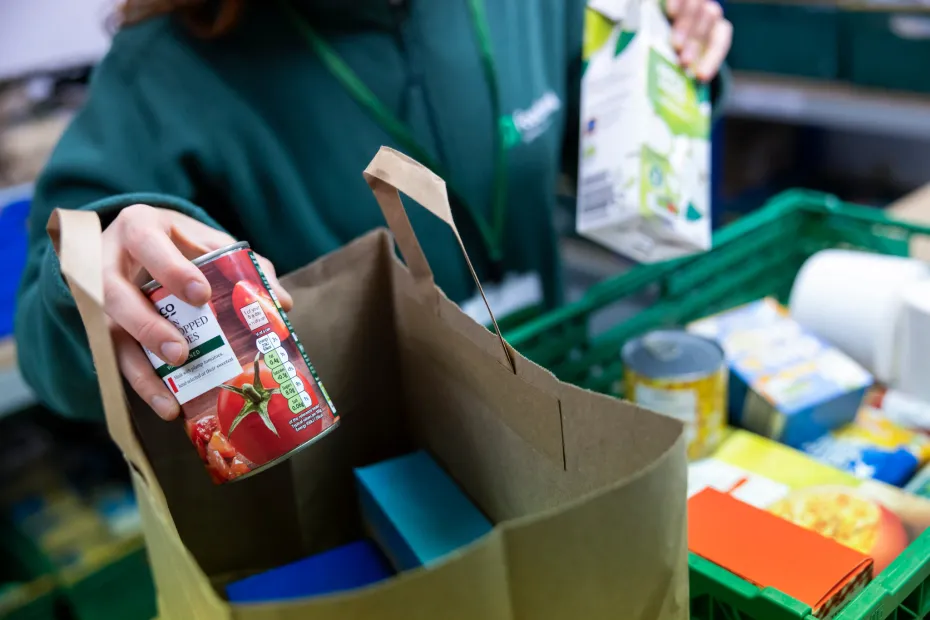
After volunteering at one of our warehouses for two years, Judith recently took on a new role focused on strengthening our relationships with local supermarkets. Using her experience working for a large supermarket retailer, Judith works with stores to create more opportunities for customers to support the Foodbank.
We spoke with Judith to learn more about the role, what she hopes to achieve and why she believes everyone has a part to play in ending the need for food banks.
Can you tell us a little bit about yourself and your connection to the Foodbank?
I currently work full time for Sainsbury’s, a position I’ve held since 2022.
Around the time I started my position at Sainsbury’s, I also began volunteering at Cambridge City Foodbank; both in the warehouse and at supermarket food drives. While I wouldn’t say I was doing anything extraordinary on my own, as a collective it was clear that we were making a real difference. If enough of us come together then surely we can make the goal of ending the need for food banks a reality.
What made you want to volunteer with the Foodbank?
I was shocked by how many people couldn’t afford the essentials and meet their basic needs – how had we reached a point where so much of the population was struggling? For me, this injustice really got me thinking: “What can I do to make a difference?”.
I had always put items into the donation bins, but before volunteering I didn’t really understand what happened afterwards. I remember asking myself, “Why am I giving somebody a tin of beans? Yes, it will help them because they’re hungry, but then what happens tomorrow?”. I also liked the way the Foodbank wasn’t afraid to talk about the political and financial causes of poverty - these are things we must discuss openly if we are truly serious about ending the root causes of the problem.
You’ve recently taken on a new role focused on supermarket donations. What does that involve?
My new role is part of the Foodbank’s strategy to enhance supermarket donations – something that’s been gradually falling for many reasons, including the cost-of-living crisis. My work will include building face-to-face relationships with the people responsible for the supermarkets’ donation bins and working with them to drive donations year on year.
Because of my background in supermarket retail, I understand how the business operates, which means we can create an environment where donations can grow. Ultimately, I see myself as a facilitator, working with supermarkets to understand what’s happening and collaborating to create a solution.
What are you hoping to achieve through this role?
The immediate focus is on some of the larger supermarkets where the bulk of our donations come. Every store is different, and the people working there know their customers better than anyone. So, it will really be a collaborative process to see how we can enhance our partnerships and it will differ from store to store.
One example has been adjusting how we position and display collection bins in store. Currently, most major supermarkets use one covered with their own branding, and we felt that potential donors didn’t really know exactly where their food was going. So, we have been working to add a Cambridge City Foodbank-branded donation bin alongside it. Currently, two supermarkets have added our branded donation bins, and I’m sure as my relationships with supermarkets continue to improve this will increase.
I’d also like to help supermarkets improve how they tell customers what their donations will support and how it helps those who use our services. There is a lot of information that needs to be drip-fed through so the average customer can easily understand it, and I think working with supermarkets to improve transparency is a great place to start.
What does the Foodbank mean to you?
When I first started volunteering, I knew I couldn’t solve the problem by myself, but I could contribute to a collective. That’s what still motivates me now. Whether you’re spending time in the warehouse, helping a food drive or having a conversation with a supermarket manager, or simply donating a tin when you can, it’s all contributing to the same goal – and that’s solving a terrible crisis.